
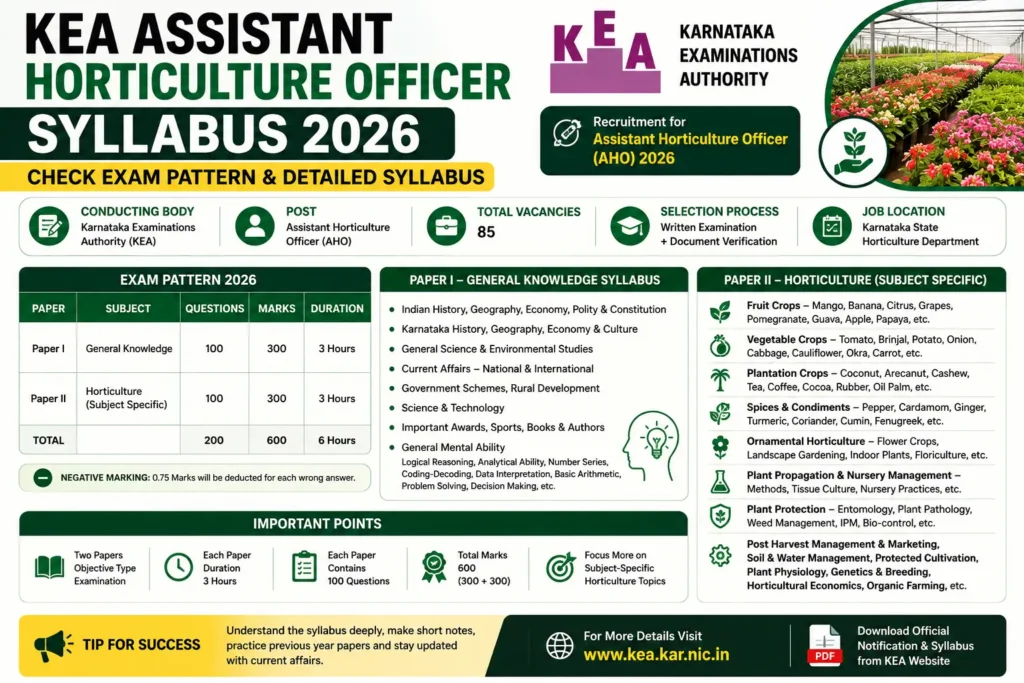
The KEA Assistant Horticulture Officer (AHO) Syllabus 2026 is an important resource for candidates preparing for the Karnataka State Horticulture Department recruitment examination. Understanding the exam pattern and subject-wise syllabus will help candidates plan their preparation and focus on the topics that carry the most weight.
The Karnataka Examinations Authority (KEA) is conducting the recruitment for Assistant Horticulture Officer and Assistant Director of Horticulture posts under the Karnataka State Horticulture Department. The 2026 recruitment includes 85 Assistant Horticulture Officer posts along with Assistant Director of Horticulture vacancies.
KEA Assistant Horticulture Officer Exam Pattern 2026
The written examination consists of two papers. Paper I covers General Knowledge, while Paper II is based on Horticulture subject-specific knowledge. Each paper contains 100 questions carrying 300 marks.
| Paper | Subject | Questions | Marks | Duration |
| Paper I | General Knowledge | 100 | 300 | 3 Hours |
| Paper II | Horticulture – Subject Specific | 100 | 300 | 3 Hours |
| Total | 200 | 600 | 6 Hours |
Negative Marking
The KEA Assistant Horticulture Officer examination has negative marking. 0.75 marks are deducted for each incorrect answer.
Candidates should therefore avoid random guessing and focus on accuracy as well as speed.
KEA AHO Syllabus 2026 – Paper I
General KnowledgePaper I covers general knowledge and related areas. Candidates should prepare the following topics:
General Studies
Indian History
Indian Geography
Indian Economy
Indian Polity
Indian Constitution
Karnataka History
Karnataka Geography
Karnataka Culture
Karnataka Economy
General Science
Environmental Studies
Current Affairs
National Current Affairs
International Current Affairs
Government Schemes
Rural Development
Science and Technology
Important Awards and Honours
Sports
Important Days
Books and Authors
General Mental Ability
Logical Reasoning
Analytical Ability
Number Series
Coding-Decoding
Classification
Analogy
Blood Relations
Direction and Distance
Data Interpretation
Basic Arithmetic
Problem Solving
Decision Making
Candidates should give special attention to Karnataka-specific General Knowledge and current affairs.
KEA Assistant Horticulture Officer Paper II Syllabus 2026
Paper II is the most important technical section for AHO candidates. It covers Horticulture subject-specific topics.
1. Scope and Importance of Horticulture
Definition and scope of horticulture
Importance of horticultural crops
Classification of horticultural crops
Economic importance
Nutritional importance
Horticulture industry
Horticultural production in India
Horticultural production in Karnataka
Commercial horticulture
Export potential of horticultural crops
2. Fruit Crops
Important fruit crop topics include:
Mango
Banana
Citrus
Guava
Papaya
Grapes
Pomegranate
Apple
Sapota
Pineapple
Jackfruit
Ber
Aonla
Custard Apple
Strawberry
Watermelon
Muskmelon
Focus on:
Origin and distribution
Varieties
Climate and soil
Propagation
Planting systems
Training and pruning
Nutrient management
Irrigation
Flowering and fruiting
Harvesting
Post-harvest management
Major pests and diseases
3. Vegetable Crops
important vegetable crops include:
Tomato
Brinjal
Chilli
Capsicum
Potato
Onion
Garlic
Cabbage
Cauliflower
Carrot
Radish
Beetroot
Okra
Peas
Beans
Cucurbits
Leafy vegetables
Important areas:
Seed production
Nursery management
Transplanting
Crop management
Irrigation
Fertilization
Protected cultivation
Harvesting
Storage
Major pests and diseases
4. Plantation Crops
Prepare the following plantation crops:
Coconut
Arecanut
Cashew
Tea
Coffee
Cocoa
Oil palm
Rubber
Important topics include cultivation practices, varieties, propagation, nutrient management, irrigation, pests, diseases, harvesting and processing.
5. Spices and Condiments
important topics include:
Black Pepper
Cardamom
Ginger
Turmeric
Coriande
Cumin
Fenugreek
Clove
Cinnamon
Nutmeg
Fennel
Tamarind
Focus on production technology, propagation, varieties, processing, storage and major pest and disease management.
6. Medicinal and Aromatic CropsImportant crops include:
Ashwagandha
Aloe vera
Isabgol
Senna
Safed MusliLe
mongrass
Citronella
Palmarosa
Mentha
Prepare their cultivation practices, medicinal importance, harvesting and processing.
7. Ornamental HorticultureThis is an important part of the Horticulture syllabus.
Flower Crops
Rose
Jasmine
Marigold
Chrysanthemum
Tuberose
Gladiolus
Carnation
Gerbera
Orchids
Dahlia
Crossandra
Landscape Horticulture
Landscape gardening
Garden design
Different types of gardens
Formal and informal gardens
Parks
Lawns
Avenue planting
Hedge and edge plants
Ornamental trees
Shrubs
Climbers
Foliage plants
Indoor plants
Bonsai
Terrace gardens
Flower arrangement
Bio-aesthetic planning
8. Plant Propagation and Nursery Management
Important topics include:
Sexual propagation
Asexual propagation
Seed propagation
Cutting
Layering
Grafting
Budding
Division
SeparationTissue Culture
Micropropagation
Nursery site selection
Nursery bed preparation
Seed treatment
Potting mixture
Nursery management
Hardening of seedlings
Protected nursery
Planting material production
9. Protected Cultivation
Prepare the following topics:
Greenhouse
Polyhouse
Shade net house
Low-cost structures
Climate control
Temperature management
Humidity management
Ventilation
Protected vegetable cultivation
Protected flower cultivation
Soilless cultivation
Hydroponics
Fertigation
Drip irrigation
10. Soil and Plant Nutrition
Important topics:
Soil types
Soil properties
Soil fertility
Soil productivity
Essential plant nutrients
Macro and micronutrients
Nutrient deficiency symptoms
Organic manures
Fertilizers
Biofertilizers
Integrated Nutrient Management
Soil testing
Leaf analysis
Problematic soils
Soil amendments
11. Water Management and Irrigation
Irrigation methods
Surface irrigation
Drip irrigation
Sprinkler irrigation
Water requirement of crops
Water-use efficiency
FertigationIrrigation scheduling
Rainwater harvesting
Water conservation
Drainage management
12. Plant Protection
Plant protection is another important technical area.
Entomology
Important insect pests
Pest identification
Pest life cycle
Damage symptoms
Pest management
Biological control
Chemical control
Integrated Pest Management (IPM)
Plant Pathology
Important diseases of horticultural crops
Fungal diseases
Bacterial diseasesViral diseases
Nematode diseases
Disease identification
Disease management
Bio-control
FAQs – KEA Assistant Horticulture Officer Syllabus 2026
What is the KEA Assistant Horticulture Officer syllabus 2026?
The syllabus consists mainly of General Knowledge in Paper I and Horticulture subject-specific topics in Paper II.
How many papers are there in the KEA AHO exam?
There are two papers in the written examination.
How many questions are asked in the KEA AHO exam?
Each paper contains 100 questions, making a total of 200 questions across both papers.
How many marks is the KEA AHO written exam?
Each paper carries 300 marks, making the total written examination worth 600 marks.
What is the duration of the KEA AHO exam?
Each paper is allotted 3 hours according to the currently available KEA AHO examination pattern.
Is there negative marking in the KEA AHO exam?
Yes. 0.75 marks are deducted for each incorrect answer.
What is Paper II of the KEA AHO exam?
Paper II is the Horticulture subject-specific paper and covers technical topics related to horticultural science.
What is the selection process for KEA Assistant Horticulture Officer?
The 2026 recruitment process consists of a written examination and document verification.

Leave a Comment